
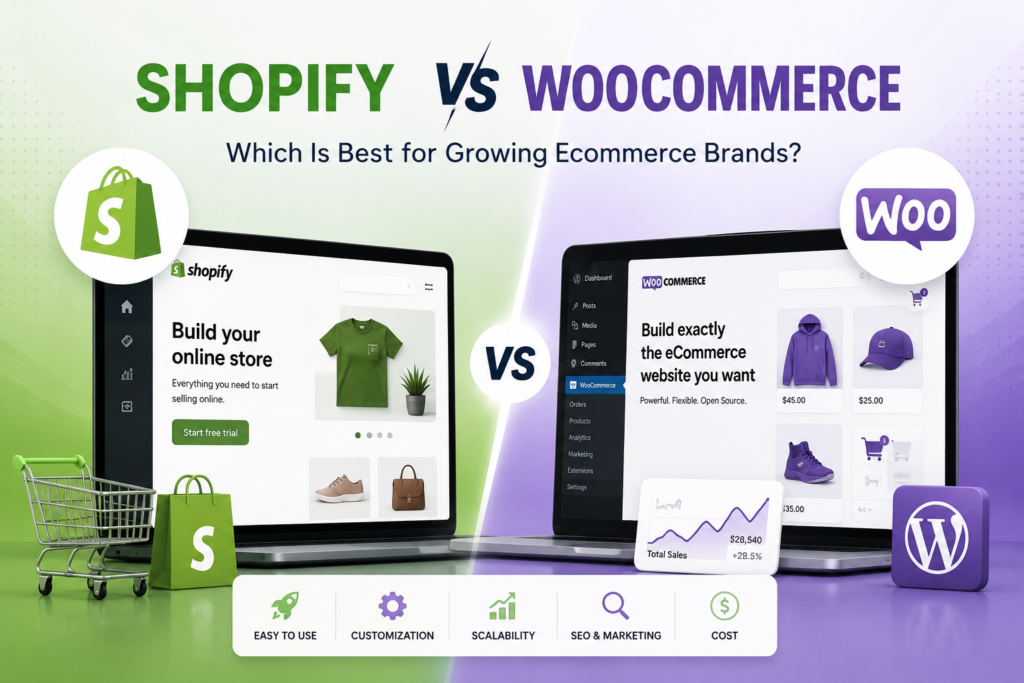
In today’s competitive ecommerce landscape, choosing the right platform can significantly impact your online store’s growth, performance, and profitability. One of the most common debates among business owners is Shopify vs WooCommerce. Both platforms are powerful, widely used, and capable of supporting successful ecommerce businesses, but they differ in terms of cost, customization, scalability, ease of use, and long-term flexibility.
If you’re planning to launch a new online store or migrate from an existing platform, understanding the differences between Shopify vs WooCommerce can help you make a smarter investment and avoid costly mistakes.
Understanding Shopify and WooCommerce
Before comparing Shopify vs WooCommerce, it’s important to understand what each platform offers. Shopify is a fully hosted ecommerce platform that provides everything needed to run an online store, including hosting, security, payment processing, and maintenance.
WooCommerce is an open-source ecommerce plugin for WordPress that transforms a website into a fully functional online store. It offers extensive customization and complete control over your website. Both platforms power millions of online stores worldwide, making them leading choices for ecommerce website development.
Shopify vs WooCommerce: Ease of Setup
One of the first factors businesses consider is how quickly they can launch their online store.
Shopify
Shopify is designed for beginners and business owners who want a simple setup process. Users can create an account, choose a theme, add products, and start selling within hours.
Benefits include:
- No coding knowledge required
- Built-in hosting
- Automatic updates
- User-friendly dashboard
- Managed security
WooCommerce
WooCommerce requires a few additional steps:
- Purchase web hosting
- Install WordPress
- Install WooCommerce
- Configure plugins and themes
While the setup process is slightly more technical, it offers significantly greater flexibility.
For businesses seeking simplicity, Shopify has the advantage. For companies wanting complete ownership and customization, WooCommerce stands out.
Shopify vs WooCommerce: Cost Comparison
Budget plays a major role when evaluating Shopify vs WooCommerce.
Shopify Costs
Shopify operates on a monthly subscription model.
Typical expenses include:
- Monthly platform fees
- Premium themes
- Paid apps
- Transaction fees (depending on payment gateway)
While predictable, costs can increase as your business grows.
WooCommerce Costs
WooCommerce itself is free.
Expenses may include:
- Hosting
- Domain registration
- Premium themes
- Ecommerce plugins
- Website maintenance
For many businesses, WooCommerce can be more cost-effective in the long term, especially for stores requiring advanced functionality.
Shopify vs WooCommerce: Design and Customization
A unique brand experience is essential for ecommerce success.
Shopify Customization
Shopify provides professionally designed themes that are mobile-friendly and easy to customize. However, advanced modifications often require Shopify’s Liquid coding language or additional paid applications.
WooCommerce Customization
WooCommerce offers virtually unlimited customization possibilities.
Advantages include:
- Full source code access
- Thousands of WordPress themes
- Extensive plugin ecosystem
- Advanced design flexibility
- Custom functionality development
Businesses that prioritize custom ecommerce solutions often prefer WooCommerce due to its unrestricted development capabilities.
Shopify vs WooCommerce: SEO Capabilities
Search engine optimization is critical for attracting organic traffic and reducing customer acquisition costs.
When comparing Shopify vs WooCommerce, SEO becomes a major deciding factor.
Shopify SEO Features
Shopify includes:
- Custom meta titles
- Meta descriptions
- Mobile optimization
- SSL certificates
- XML sitemaps
These features provide a solid SEO foundation.
WooCommerce SEO Features
WooCommerce benefits from the powerful WordPress ecosystem and advanced SEO tools.
Benefits include:
- Complete URL control
- Advanced schema markup
- Blog integration
- SEO plugins
- Content marketing flexibility
For businesses focused on long-term organic growth, WooCommerce often provides stronger SEO opportunities due to its greater control over technical SEO elements and content management.
Shopify vs WooCommerce: Performance and Speed
Website speed directly impacts conversions and search rankings.
Shopify Performance
Shopify manages hosting and optimization automatically.
Benefits include:
- Reliable infrastructure
- CDN integration
- Automatic updates
- Consistent performance
WooCommerce Performance
WooCommerce performance depends on:
- Hosting quality
- Optimization practices
- Theme selection
- Plugin management
With proper ecommerce website optimization, WooCommerce stores can achieve exceptional loading speeds and performance levels.
Shopify vs WooCommerce: Payment Options
A smooth checkout process improves customer experience and increases sales.
Shopify Payments
Shopify supports:
- Shopify Payments
- PayPal
- Stripe
- Multiple payment gateways
Setup is straightforward and beginner-friendly.
WooCommerce Payments
WooCommerce supports:
- Stripe
- PayPal
- Square
- Regional payment gateways
- Custom payment integrations
Businesses operating internationally often appreciate WooCommerce’s flexibility when integrating local payment solutions.
Shopify vs WooCommerce: Scalability for Growing Brands
Growth-oriented businesses need a platform that can scale efficiently.
Shopify Scalability
Shopify excels in handling growth because:
- Hosting is managed
- Security is included
- Infrastructure scales automatically
Fast-growing ecommerce brands can expand without worrying about server management.
WooCommerce Scalability
WooCommerce can also scale effectively when paired with high-performance hosting.
Advantages include:
- Unlimited product listings
- Custom database optimization
- Enterprise-level flexibility
- Advanced ecommerce integrations
For businesses planning complex ecommerce ecosystems, WooCommerce provides greater long-term scalability and ownership.
Shopify vs WooCommerce: Security
Security is a critical concern for online retailers.
Shopify Security
Shopify handles:
- SSL certificates
- PCI compliance
- Platform updates
- Security monitoring
This makes security management easier for store owners.
WooCommerce Security
WooCommerce security depends on:
- Hosting provider
- Security plugins
- Website maintenance
- Regular updates
When managed correctly, WooCommerce can be highly secure while giving businesses greater control over their environment.
Which Platform Is Better for Your Business?
The answer depends on your goals.
Choose Shopify if you:
- Want a quick launch
- Prefer minimal technical involvement
- Need managed hosting
- Value simplicity
Choose WooCommerce if you:
- Need extensive customization
- Want full ownership of your website
- Prioritize SEO flexibility
- Plan advanced ecommerce functionality
- Need scalable custom development
For many growing ecommerce brands, WooCommerce offers stronger long-term value because of its flexibility, SEO advantages, and lower ongoing costs. However, Shopify remains an excellent solution for businesses seeking convenience and ease of management.
Final Verdict: Shopify vs WooCommerce
The debate around Shopify vs WooCommerce ultimately comes down to convenience versus control. Shopify provides an all-in-one solution that simplifies store management, while WooCommerce offers unmatched flexibility and customization opportunities.
Businesses that prioritize rapid deployment and simplicity may find Shopify the better option. Companies focused on advanced SEO, custom ecommerce development, and long-term scalability often choose WooCommerce. Before making a decision, evaluate your budget, technical requirements, growth plans, and digital marketing strategy to ensure the platform aligns with your business objectives.
Partner with Creative Pixel Solutions
Choosing the right ecommerce platform is only the first step. To maximize online sales, you need a professionally designed, conversion-focused, and SEO-optimized store.
Creative Pixel Solutions specializes in:
- Ecommerce Website Development
- Shopify Development Services
- WooCommerce Development Services
- Ecommerce SEO Services
- Website Speed Optimization
- Conversion Rate Optimization
- Digital Marketing Solutions
Whether you’re launching a new online store or upgrading an existing one, our team can help you build a scalable ecommerce solution tailored to your business goals.
Contact Creative Pixel Solutions today for a free consultation and discover the best